


11 Reasons the Good Juju Hair Elixir Is the Overnight Ritual Thinning Hair Actually Needs

1
Why your scalp needs a serum — not just a shampoo
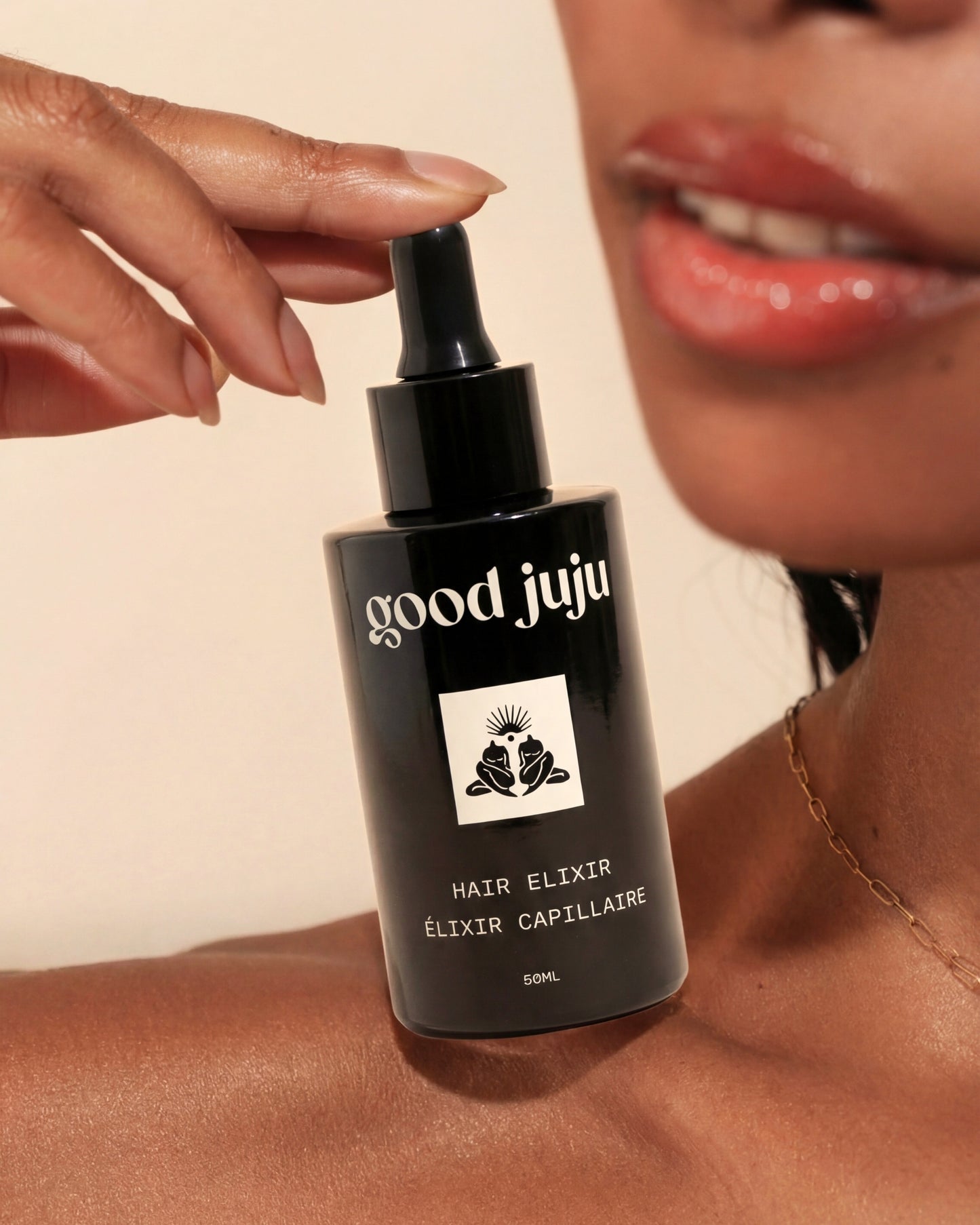
Think about how much care goes into the skin on your face. Serum. Moisturizer. Targeted actives left on overnight. Now think about your scalp — where every strand of hair is born. For most people it gets nothing but shampoo, rinsed off before it can do much of anything. The Good Juju Hair Elixir treats your scalp the way a quality skincare serum treats your face: concentrated botanical actives applied directly to the scalp dermis 2–3 nights per week and left overnight, where they can absorb undisturbed into the tissue where follicles live.
WHY PRE-WASH APPLICATION MATTERS
• Hair follicles live in the scalp dermis — they need nourishment, anti-inflammatory support, and barrier protection that a rinse-off shampoo can’t meaningfully deliver
• Overnight application gives active compounds the time and conditions to absorb where they’re needed most, without being removed by washing
2
Why rosemary oil is more than a trend — and what the peer-reviewed research actually says
Rosemary is one of the most researched botanicals for hair and scalp health. The peer-reviewed literature on its active compounds is genuinely substantive — and it’s the three distinct mechanisms, not just the oil itself, that make it worth talking about. Applied 2–3 nights a week before bed, the actives absorb into the scalp dermis during the hours it’s most receptive.
THREE ACTIVE COMPOUNDS — THREE MECHANISMS
• Rosmarinic acid — reduces prostaglandin D2 (PGD2) levels and suppresses pro-inflammatory mediators including TNF-α and IL-1β at the scalp [3]
• Carnosic acid — supports follicle growth activation and reduces scalp inflammation via nitric oxide inhibition and NF-κB suppression [4]
• Ursolic acid — inhibits 5-alpha reductase, the enzyme that converts testosterone into DHT; confirmed as an effective 5-AR binding molecule in peer-reviewed computational and in vitro analysis [5]
3
What Black Seed Oil does that rosemary can’t — and the clinical study in women that backs it up
Nigella Sativa’s active compound thymoquinone addresses three pathways rosemary doesn’t touch. This is the most straightforward explanation for why single-oil products often disappoint — they’re addressing one or two of the biological reasons hair thins, while others go unchecked. A 2013 double-blind, placebo-controlled pilot study in 20 women with telogen effluvium found significant improvement in hair density and thickness after three months of topical Nigella sativa application [4] — one of the few botanicals with direct clinical evidence specifically in women with stress-related shedding.
WHAT THYMOQUINONE DOES
• Inhibits 5-alpha reductase, reducing how much testosterone is converted into follicle-damaging DHT
• Suppresses prostaglandin D2 (PGD2), the inflammatory mediator elevated in thinning scalp tissue that compounds follicle miniaturization
• Controls Malassezia — the yeast overgrowth that contributes to scalp itching, inflammation, and shedding
“Baby hairs are growing, hair is feeling fuller all over... The weekly hair 'stash' on my bathroom floor is definitely less overwhelming.”
— Sarah C

5
DHT is quietly shrinking your follicles. Here’s how the Elixir addresses it from two independent directions.
An enzyme in your scalp called 5-alpha reductase converts testosterone into DHT, which progressively shortens the active growth phase of each hair cycle until follicles stop producing visible hair. An inflammatory compound called PGD2 accumulates alongside DHT activity and compounds the damage. Single-ingredient products often plateau because they only address one point in this chain. The Elixir applies two completely independent botanical sources of DHT-pathway intervention overnight, each working through a distinct mechanism.
TWO-PATHWAY DHT INTERVENTION IN ONE OVERNIGHT FORMULA
• Rosemary ursolic acid — inhibits 5-alpha reductase; in vitro analysis found rosemary inhibited approximately 80% of 5-alpha reductase activity [3]
• Black Seed thymoquinone — a second, independent 5-alpha reductase inhibitor from a completely different botanical source, and additionally suppresses PGD2 — addressing both the hormonal and inflammatory components of follicle miniaturization simultaneously [4][5]
5
The in vitro science behind Coffee Seed Oil — and why your hair’s growth phase matters more than you think
One of the less visible ways thinning progresses is that individual strands spend less and less time in their active growth phase before shedding — each cycle producing a shorter, finer result. In laboratory testing, caffeine stimulated follicle keratinocyte growth and directly counteracted testosterone-induced follicle suppression in vitro (Fischer et al., 2007) [6]. Coffee Seed Oil delivers this in clean botanical form alongside chlorogenic acid and ferulic acid — antioxidant polyphenols that protect follicle DNA from the oxidative damage that accelerates thinning over time.
THE LABORATORY EVIDENCE
• Fischer et al. (2007) used a human hair organ culture model to demonstrate caffeine’s effect on follicle keratinocyte proliferation and testosterone-induced suppression in vitro [6]
• Proposed mechanism: inhibition of phosphodiesterase inside dermal papilla cells, increasing intracellular cAMP and extending the active growth phase
“My hair is shinier and softer... I have noticed some regrowth and hair fall has lessened.”
— Sareah R

6
Why your scalp’s moisture barrier matters for hair growth — and how Sweet Almond Oil restores it
The scalp has its own hydrolipid film — a lipid-and-water emulsion that seals moisture in, maintains pH, and protects follicles from environmental stressors. When this barrier breaks down from hormonal shifts, aging, or harsh product use, the follicle environment becomes less forgiving and new growth emerges into a hostile setting. Sweet Almond Oil’s oleic acid content (~70%) closely mirrors the skin’s own lipid matrix, integrating seamlessly into the hydrolipid film to replenish what has been lost — producing a scalp that feels less tight, less reactive, and more capable of supporting growth.
THE EVIDENCE FOR SWEET ALMOND OIL
• Blaak & Staib (2022) confirmed that oleic acid-rich oils including Sweet Almond Oil support skin barrier function and reduce transepidermal water loss [7]
• Note: mechanisms well-established in general lipid science; no clinical study has examined sweet almond oil specifically on the scalp in isolation
7
How Castor and Argan Oils seal what Sweet Almond restores — and the RCT in postmenopausal women
Rebuilding the scalp barrier is only half the equation — the other half is sealing it so hydration and active ingredients aren’t lost overnight. Castor Oil’s ricinoleic acid (~90% of its fatty acid composition) forms a semi-occlusive layer that dramatically reduces transepidermal water loss while you sleep, confirmed in a 2017 Journal of Cosmetic Dermatology study [8]. Argan Oil’s unique phytosterols — schottenol and spinasterol — reduce inflammation and restore the skin barrier at the dermal level. A 60-person randomized controlled study in postmenopausal women found topical argan oil significantly decreased TEWL and increased epidermal water content over 60 days — directly relevant to the audience whose scalp barrier is most compromised [9].
“My scalp feels healthier overall. No dryness or itchiness. The best feeling was not having my scalp irritating me — especially this time of year when I usually have flare-ups.”
— Larissa, Week 2 Review · Hair Elixir Trial
8
Pure botanical ingredients. Nothing synthetic. Here’s why that matters more than you might think.
The Hair Elixir’s ingredient list is nine plant oils and a plant-derived antioxidant — nothing synthetic, no masking fragrance, no parabens, no silicone, no PEGs. For women with sensitive or compromised scalp barriers — common in perimenopause and after years of medicated shampoo use — synthetic chemicals can penetrate to dermal nerve layers and cause burning or inflammation. A 100% botanical formula eliminates that risk entirely, and as the barrier-rebuilding ingredients do their work, scalp reactivity tends to decrease over time rather than persist.
WHAT’S NOT IN THIS FORMULA
• No synthetic preservatives
• No silicone
• No PEGs
• No synthetic fragrance
• No parabens
9
A 2-minute ritual, 2–3 nights a week. Here’s what the timeline actually looks like.
Apply 1–2 droppers to the scalp before bed, two or three nights a week. Massage in. Sleep. Wash in the morning. That’s the entire ritual. The results women report are specific rather than vague — baby hairs at the hairline, reduced brush count, fuller roots, less shedding in the drain. The timeline below reflects what consistent use looks like across the first 12 weeks.
WHAT TO EXPECT AND WHEN
• Weeks 1–3: Scalp comfort returns. Less tightness, itching, and dryness. Strands feel softer.
• Weeks 4–8: Less hair in the brush and drain. Roots feel fuller. Scalp more balanced.
• Weeks 9–12: Baby hairs visible at hairline. Noticeably fuller appearance. Better length retention.
“Noticeable hair growth only after 2 applications. It’s been about 12 weeks and I am amazed at all the new hair growth. My hair is thicker and shinier and my scalp is no longer visible where I used to have thinning hair.” — Sharda A.
9
Why this system is especially well matched to hormonal hair changes — and who else it’s designed for
As estrogen declines during perimenopause and menopause, scalp skin ages the same way the rest of the skin ages: collagen quality dips, blood supply decreases, low-grade inflammation increases. The follicle environment becomes less forgiving. Fibers come in finer, break more easily, and roots fall flat sooner. The formula in this bundle addresses that exact state — without overpromising. It will not reverse a hormonal transition. What it does is help fragile, life-stage-changed hair behave more like resilient hair again.
DESIGNED FOR ALL OF THE FOLLOWING
• Perimenopause and menopausal hair changes
• Stress-related shedding (telogen effluvium)
• Postpartum hair loss
• Post-pill shedding
• Thinning that shows up everywhere at once — wider part, thinner ponytail, less density overall
“I am in my late 40s with long, fine, wavy hair that over the last few years I have noticed thinning due to perimenopause. Words cannot express how happy I am. My hair is so soft, feels fuller and so healthy.” — Rita K.

10
How the cost compares
At $63 CAD for 50ml used 2–3 times per week, the Hair Elixir lasts 4–8 weeks per bottle — a lower per-use cost than most salon treatments and dramatically less than a single PRP injection session ($500–1,500 each). Vegan. Leaping Bunny certified. Canadian-made.
11
Why this works for perimenopause, postpartum, stress shedding, and post-pill — not just one cause
Whatever set your thinning in motion, the underlying biology that needs addressing is largely the same: DHT activity, scalp inflammation, shortened growth cycles, barrier disruption, and oxidative damage. The Hair Elixir addresses all of these pathways simultaneously — in a 2–3x weekly ritual that takes minutes and requires no prescription, no appointment, and nothing synthetic.
THIS FORMULA IS DESIGNED FOR
• Perimenopause and menopausal hair changes
• Stress-related shedding (telogen effluvium)
• Postpartum hair loss
• Post-pill shedding
• Thinning that shows up everywhere at once — wider part, thinner ponytail, less density overall
Your scalp has been waiting for this level of care.


Real Women. Real Results.


